CUTTING and BENDING PROCESSES
The parts whose three-dimensional designs are made are redrawn in two dimensions according to the manufacturing processes and are subjected to operations according to the order of operation. The parts to be cut with laser or plasma are primarily cleaned and processed in laser or plasma benches according to material properties and part thickness. Parameters such as notch width, material edge surface roughness, amount of slag, tolerance control and flatness are important in the quality of the cutting process. The products with dimensional controls are sent to the next process (cold forming).
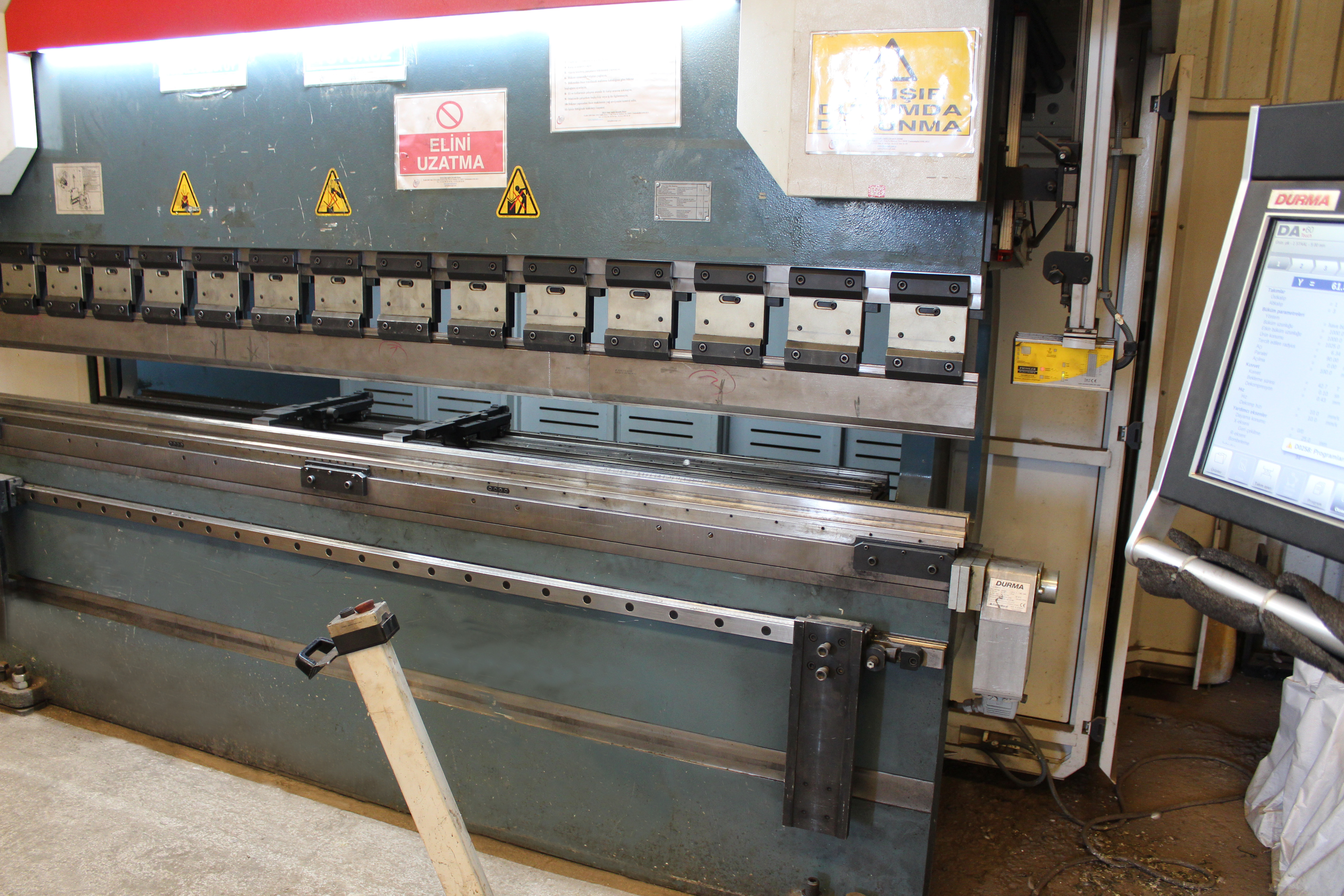
For the bending process, the press brake is subjected to the cold forming process in the press line. Semi-finished products, whose bending details are available in the technical drawings, are sent to the next process line (machining, welded manufacturing or assembly) after measurement controls are made.
Laser Cutting Procedure
The laser light hitting the material surface is absorbed by the material and the material heats up. This resulting heat can vaporize the material or allow the material to be processed. Parameters such as notch width, material edge surface roughness, amount of slag, tolerance control and flatness are important in the quality of the cutting process.
Laser Cutting Process
The laser beam is focused vertically on the material to be cut. The cutting process is carried out by giving auxiliary gas from the cutting head located between the laser focus lens and the material to be cut. Laser light and auxiliary gas melt the part in the focused area and perform the cutting process. Due to the heat generated during cutting, the material to be cut becomes molten. This melting is called laser cutting. The laser light acts as a heat source during the cutting process.
As the material thickness increases, the angle of the laser light on the material loses its steepness and becomes slightly curved. The slag and surface roughness formed after cutting are directly proportional to the material structure and cutting parameters. The power of the laser, focus position and auxiliary gas pressure are parameters that affect the debris height.
Laser cutting takes place by melting the material. Preheating occurs at the first contact of the laser light and the material. The heating progresses into the material and melting occurs in the upper part of the material. The melts allow the material to become fluid and separate.
Laser Advantage in Cutting Process
* There are many advantages of using lasers in the cutting process.
* All kinds of organic and inorganic materials can be cut perfectly by laser.
* There is no need for any processing after laser cutting.
* Material of any geometric shape is cut with high accuracy.
* Laser cutting machines do not experience wear or dullness after use. Long-term savings are achieved as the material head does not become blunt.
* It ensures the most efficient use of materials.
* Minimum waste rates reduce costs.
* Since the cutting is done without contact, a scratch-free product is obtained ready for assembly.
* There will be no burrs and heat-induced roughness on the cut panel or surface.
* Easy to operate, low cost.
* Crushing and warping do not occur in the material during cutting.
* It offers a much more flexible working opportunity as a design.
Oxygen is used as auxiliary gas in carbon steel laser cutting. Oxygen, which reacts with iron, doubles its melting power, increasing the yield. Thus, the molten material is separated more easily.
Oxygen or nitrogen is used as auxiliary gas in stainless steel. Oxygen causes an oxide layer on the cut edges. In the case of using nitrogen, the formation of oxide layer is prevented.