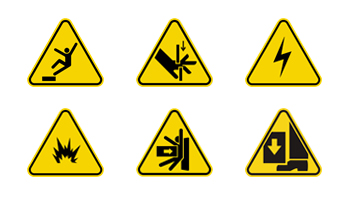
RISKS IN USE OF SCISSORS PLATFORM
Electric Scissor Lift, like any vehicle, carries risks. Although the vehicle is used by trained operators, it contains many risks due to both user errors and external factors. The risks listed below have emerged as a result of the risk analysis studies and are indicated in order to guide the people who will use the vehicle and to take the necessary precautions.
1. RISK OF FALLING
- Before planning and organizing the work to be done, make sure that the issues related to falling from a height are included in the emergency plan while this planning is being done.
- Before starting the vehicle, make sure that the platform door is closed and all guardrail locks are engaged.
- Make sure that the locking system of the additional platform extension part to the main platform is locked.
- Persons on the vehicle platform must wear safety vests and the vest must be fixed at the designated safety attachment points on the platform guardrails.
- The equipment for safe working at heights must be regularly checked and maintained. The use of unsuitable equipment should be avoided.

2. RISK OF ELECTRIC / HIGH VOLTAGE SHOCK
- The vehicle's platform is not insulated and does not provide protection against any electrical current or leakage. For this reason, the vehicle should be operated at a safe distance, taking into account the distances specified in the table below (Figure 2).
- In locations close to power lines on which there is electric current, and especially where power lines do not look healthy, rupture, abrasion, etc. Determine the safe working area of the vehicle, taking into account the mishaps that may occur in such situations.
- While working with the welding machine on the vehicle platform, do not remove any part of the vehicle to the chassis.

3. RISK OF TIPOVER
Strictly follow the instructions below while on the platform:
- Before using the machine in any indoor or outdoor area, confirm that the floor is suitable for the tire surface pressure generated by the vehicle's weight and load capacity. For these values, refer to the maximum value in the “Technical Specifications of Standard Vehicles” (See Section 4).
- The load capacity of the vehicle is specified in the manual, and distribute it to the center of the platform and at equal distances, taking into account the size and weight of the load. For load capacities (See Chapter 4).
- Operate on inclined surfaces in the x and y coordinates of the vehicle within the working limits. (See Chapter 4).
- Never make the vehicle make sharp turns on slopes.
- Avoid sudden movements and be careful when reversing the vehicle's driving direction. The front and driving direction of the vehicle is the side with the wheel group connected to the steering system, and the rear of the vehicle is on the side with the ladder. (See Chapter 5)
- Make sure that there are absolutely no potholes, bumps, sloping areas, obstacles, debris or floor coverings that could hide other hazards in the vehicle's working area. If such external factors are required, the distance between the vehicle and the vehicle must be at least 1 m. make sure it happens.
- Do not enlarge the platform dimensions of the vehicle without the manufacturer's permission, and do not make any additions that will affect the tipping moment.
- Do not apply external forces to the platform when the vehicle's platform is raised. Never tow with another vehicle or equipment by tying it from the platform.

4. RISK OF BURNING AND EXPLOSION
- When checking the vehicle, definitely use your safety equipment (glasses, gloves, hard hat, steel-toed shoes, etc.).
- Never operate the vehicle in the presence of flammable and explosive materials.
- Since the vehicle's battery (for lead-acid batteries) generates gas as a result of chemical reaction during charging, do not approach the battery with any object or cigarette that produces flames or sparks against the risk of burning/explosion.
- Do not make a chassis with metal objects on the terminals of the batteries.
- Battery chargers may overheat during operation, so do not touch them with bare hands.
- During operation, hydraulic equipment may overheat due to intense work, so do not touch it with bare hands.
- Since hydraulic equipment works under pressure, do not disassemble any hydraulic equipment while the system is operating, and do not change the set settings.
- The hydraulic hoses in the system are high pressure resistant equipment with 100% explosion tests. In order to avoid injuries as a result of wearing out of the hoses, bursting of the hoses and contact of the pressurized hydraulic oil with the skin, replace the worn hydraulic hoses, which are detected after visual inspection, by reporting the product code and obtaining a new one.

5. RISK OF COLLISION AND CRUSHING
- All operators (working on the platform and on the ground) driving the vehicle must wear a hard hat in accordance with the EN 397 2012+A1:2012 standard.
- In cases where the safety lock is not attached while working with the vehicle, do not place hands, head, etc. between the scissors. other limbs should not be inserted.
- It is necessary to pay attention that the working area of the vehicle is clean and that there are no pipes, cables, installations, ventilation and heating systems, etc. materials that may pose any danger at the operator's head while raising, lowering and moving the vehicle in the raised state.
- While working on the platform, the operator must keep his whole body within the limits of the guardrail.
- When there is an environment in the work area that obstructs the operator's view of the platform, other personnel on the ground should assist.
- In cases where it is necessary to have persons other than operators in the work area, at least 1.8 meters from the vehicle. should be kept away.
- Be aware of the vehicle's braking distances at different speeds and slow down first, then stop, depending on the distance you will stop.
- Do not drive the vehicle in narrow and restricted areas and at high speed when reversing.
- When working at height, always proceed in the forward direction by checking the environment and if there is no necessity, use the vehicle safely by paying attention to the moving-immobile objects, people and immovables in the vicinity to avoid collision/collision/crushing.
- While the vehicle is running, prevent ground personnel from being under or next to the vehicle and ensure that they are at a safe distance (at least 1 mt.).
- If the vehicle is wanted to be used by means of the control box from the ground while the vehicle is in bulk, at least 1 m from the vehicle. must stay away.